
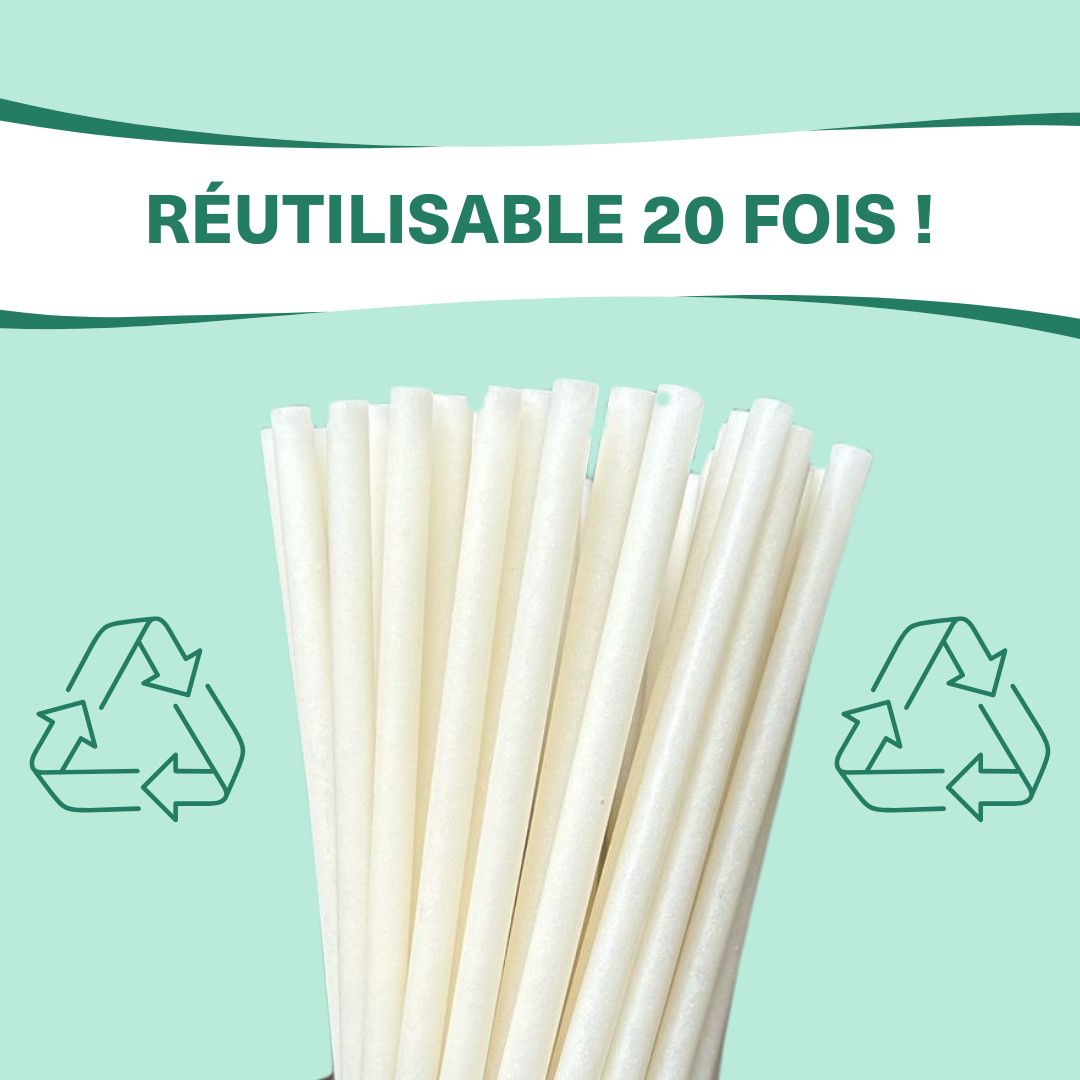
Our new plant fiber: a sustainable alternative for straws
Our new plant fiber: a sustainable alternative for straws
Our new plant fiber is revolutionizing the world of eco-friendly alternatives to plastic straws. Biodegradable and safe for the planet, this fiber processed in France embodies the future of responsible straws.
A concrete answer to environmental challenges
Faced with the gradual ban on single-use plastics in Europe, Straws-Berry innovates with a plant fiber designed specifically for straws. Derived from plants such as sugar cane and sugar beet, this material is fully biodegradable.
It provides a concrete answer to environmental challenges by upcycling plant co-products. A virtuous approach combining ecology, innovation and industrial know-how.
Production 100% in France
All production takes place in France: the fiber is processed using gentle mechanical or thermal methods, environmentally friendly and free of harmful chemicals.
This choice guarantees full traceability of manufacturing, a controlled carbon footprint and the preservation of French industrial know-how.
A strong and biodegradable alternative
Unlike paper straws, often criticized for their fragility or unpleasant taste, this new plant fiber is strong, neutral in taste and pleasant to use.
It withstands moisture without breaking down too quickly and leaves no lasting trace in the environment, at sea or on land.
Multiple uses in food service
This plant fiber has already been adopted by several restaurants, bars and hotels mindful of their environmental impact. It fully complies with European standards and can be used for both hot and cold drinks.
Its understated, natural design also appeals to consumers, who see it as a sign of quality and environmental commitment. It is quickly becoming a symbol of more responsible consumption.
A lever for the circular economy
The production of this plant fiber is part of a circular economy model: it upcycles plant co-products that usually go unused, creating new added value.
This model reduces waste, creates industrial activity in France and strengthens sustainable supply chains.
A low environmental impact
Compared with plastic materials or imported disposable straws, this plant fiber processed in France emits little CO₂: local production avoids long-distance transport of finished products.
It pollutes neither soil nor oceans, even at the end of its life. It thus meets the criteria of a sober, efficient innovation, fully aligned with the goals of the ecological transition.
Institutional and public support
Local authorities, regions and incubators actively support this type of innovation. Funding programs and calls for projects make large-scale deployment easier.
Consumers, for their part, are increasingly attentive to where products are made and what happens at the end of their life. They favor natural, ethical alternatives produced locally. This fiber ticks all the boxes.
An industrial opportunity for France
With this plant fiber, France is positioning itself in bio-based alternative materials. Jobs are being created and skills are being redeployed into sustainable sectors.
It is also an answer to the dependence on disposable straws imported from Asia: producing in France becomes possible, in line with today's economic and ecological challenges.
Challenges ahead
Scaling up this fiber still requires investment in R&D, logistics and training. Certain industrial standards also need to be adapted to the specific characteristics of this natural material.
But the outlook is encouraging: performance tests, customer satisfaction and the stability of the business model pave the way for rapid adoption.
Conclusion: the straw of a new world
Our new plant fiber embodies exemplary innovation. Eco-friendly, high-performing, cost-effective and produced 100% in France, it turns an everyday object into a lever for global change.
By choosing this alternative, we contribute to a more sustainable model, where every action counts to preserve the planet. The plant fiber straw produced in France thus becomes a symbol of a more responsible future.